Clear goals. Flexible pathways. Meaningful evidence of learning.
How else could students learn this, show what they know, and connect with the curriculum? Universal Design for Learning (UDL) gives us a framework for asking those questions while keeping course learning outcomes at the center.
Start small: choose one upcoming lesson or assignment. Clarify the goal, anticipate a barrier, and design an option that helps students reach the same goal.
On this page: Understand UDL · Explore strategies · Write strong objectives · Use Bloom’s taxonomy · Redesign an assignment · Plan your next step
What is Universal Design for Learning?
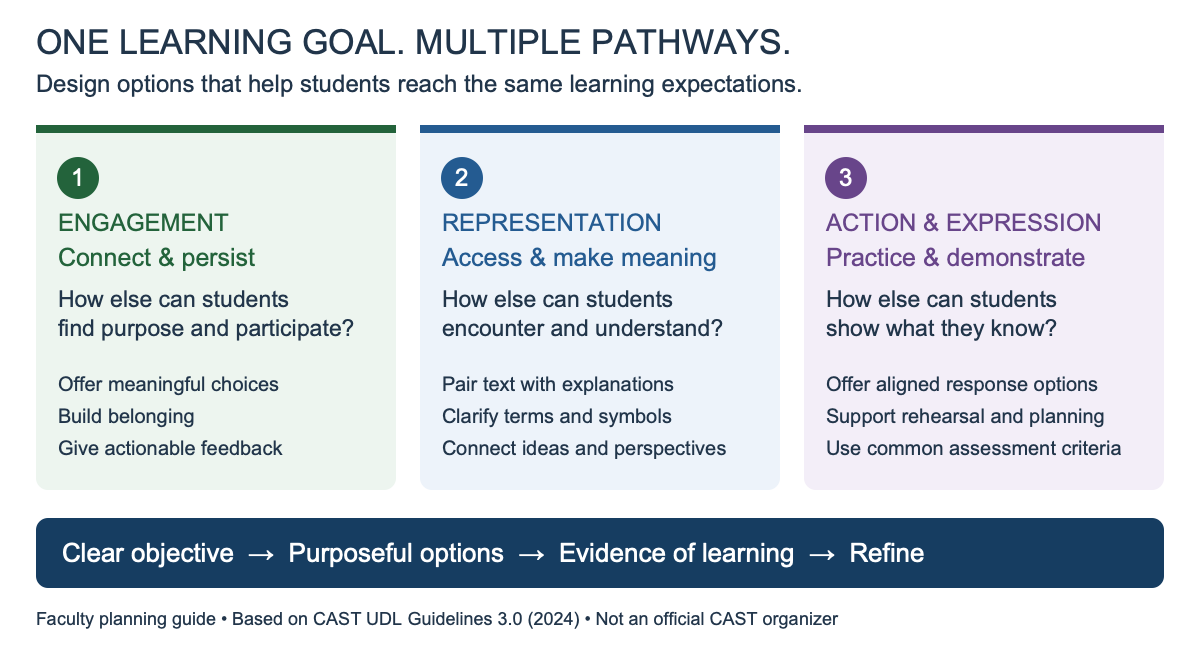
UDL is a framework for designing learning environments that anticipate learner variability and reduce barriers to participation. CAST’s UDL Guidelines 3.0 organize this work around three principles: engagement, representation, and action and expression. The goal is learner agency: students developing purpose, resourcefulness, and the ability to take action in their learning. Explore CAST’s UDL Guidelines 3.0.
Use UDL during planning, then refine your design with students’ feedback and evidence of learning. You do not need to apply every guideline to every lesson. Begin with a barrier that matters in your course.
Three ways to open access to learning
The graphic below is a faculty planning guide inspired by CAST’s framework. The examples are starting points to adapt to your discipline.
Engagement: create reasons and ways to participate
CAST emphasizes meaningful choice, relevance, belonging, support, and reflection. Read the engagement guidelines.
- Make the purpose visible. Introduce an activity by naming the outcome and where students might use the learning beyond this class.
- Offer bounded choices. Let students select one of two case studies or propose a relevant example while working toward the same objective.
- Build participation pathways. Give thinking time before discussion, invite written preparation, and use clear roles in group work.
- Support persistence. Break a project into milestones, give feedback students can use on the next attempt, and ask them to reflect on a strategy that helped.
Representation: make ideas accessible and understandable
Representation concerns how students access information and build meaning, including whose experiences and perspectives appear in the curriculum. Read the representation guidelines.
- Pair complementary explanations. Accompany a diagram with a concise text explanation; pair a worked calculation with a description of the reasoning.
- Prepare accessible materials. Use headings, descriptive links, readable documents, meaningful alternative text for images, and accurate captions and transcripts for media.
- Make language visible. Define technical terms, explain symbols, and show annotated examples before asking students to work independently.
- Connect knowledge. Invite students to connect a new concept to prior learning and examine examples from varied communities and contexts.
Action and expression: support practice and evidence of learning
This principle addresses how students navigate tasks, organize their work, and communicate learning. It includes support for planning and monitoring progress. Read the action and expression guidelines.
- Separate the goal from the format. If the goal is evaluating evidence, consider an essay, recorded explanation, or annotated presentation that meets common criteria.
- Provide rehearsal. Use a low-stakes practice attempt, a model, and feedback before the final assessment.
- Make the process manageable. Share a planning template, interim deadlines, and a checklist students can use to monitor their progress.
- Keep essential skills visible. If the objective is oral communication, writing, or a hands-on procedure, assess that skill directly while offering appropriate supports.
A useful distinction: in CAST’s framework, representation is about access to and understanding of information. Students representing or demonstrating their own learning falls primarily under action and expression.
Strong objectives make flexible pathways possible
Course learning outcomes describe what students should be able to demonstrate by the end of a course. Lesson and unit objectives identify more specific performances that build toward those outcomes. Strong objectives help faculty decide what evidence to collect and help students understand what success looks like.
An objective alone does not establish mastery. Faculty also need aligned assessment tasks, clear criteria, and sufficient evidence across the course. A completed activity or a participation score may not show whether a student has achieved the intended outcome.
Build an objective:
By the end of [lesson/unit], students will be able to [observable action] + [content or skill] + [relevant conditions] + [success criteria].
Ask: What must students know or do? What would convincing evidence look like? Which parts of the task are essential to the outcome, and which can vary?
From a broad intention to observable evidence
Broad intention: “Students will understand credible sources.”
More useful objective: “Given two sources addressing the same claim, students will evaluate their credibility using authorship, evidence quality, and relevance, and justify a judgment with specific evidence from each source.”
Evidence to assess: accurate application of the criteria, relevant supporting evidence, and a justified judgment. Specify the proficiency threshold in a shared rubric. When writing itself is not the target, the evidence could appear in written, spoken, or annotated visual form.
Alignment check: if the outcome asks students to evaluate, a quiz that only asks them to recall definitions is insufficient. Plan practice and assessment that require evaluation, then use the results to decide what support or further practice is needed.
Use Bloom’s taxonomy to name the thinking
The revised Bloom’s taxonomy offers six categories for describing cognitive work. Use them to align objectives, practice, and assessment. Choose the thinking appropriate to the outcome; not every task needs to involve creating. The whole task and its context matter, not just the verb. Explore Iowa State University’s Bloom’s taxonomy resource.
| Thinking | Example task |
|---|---|
| Remember | Identify the parts of a cell. |
| Understand | Explain how a cell membrane regulates exchange. |
| Apply | Use a model to predict movement across a membrane. |
| Analyze | Compare results and distinguish plausible explanations. |
| Evaluate | Defend the best explanation using the available evidence. |
| Create | Design an investigation that tests the explanation. |
These categories can guide a sequence of practice, but they are not a mandatory staircase for every lesson. Students may move among them as they investigate a problem. A presentation, essay, or video can involve any of these kinds of thinking: the medium does not determine cognitive demand.
Put it into practice: redesign one assignment
Example course outcome: evaluate claims using credible evidence. The following is an illustrative redesign; adapt the topic, criteria, and proficiency standard to your course.
Starting assignment
“Watch a lecture and write a three-page paper about a claim.” This names activities and a product, but leaves the learning evidence and evaluation criteria unclear.
Redesigned assignment
- Name the objective. Evaluate two sources about the same claim using authorship, evidence quality, and relevance; justify a judgment with specific evidence.
- Anticipate barriers. Students may have difficulty accessing the lecture, interpreting unfamiliar vocabulary, choosing a topic, or organizing their reasoning.
- Offer ways to learn. Provide a captioned mini-lecture with a transcript, an annotated source comparison, and a short glossary. Model how one piece of evidence supports a judgment.
- Offer ways to engage. Let students choose from several relevant claims. Ask them to explain why the claim matters to a community, workplace, or personal interest. Use a checkpoint to help them narrow the topic.
- Offer ways to show learning. Accept a written analysis, an audio explanation with a source list, or an annotated slide presentation. Every option must evaluate both sources and make the reasoning and evidence easy to locate.
- Assess common criteria. Use the same rubric for source evaluation, quality of evidence, and justification. Share examples and define what proficient work looks like before students begin.
- Review and revise. Compare evidence of learning across the options. Ask students which supports helped and where they encountered barriers. Adjust the next assignment accordingly.
Keep the assessment valid: if this were a writing course with an outcome about composing an academic argument, written composition would remain part of the assessment. Choice might instead involve topic, planning tools, feedback opportunities, or stages of drafting.
A planning checklist for your next lesson
Use these prompts with one assignment, then bring your ideas to a colleague or the CTL.
- Outcome: Which course learning outcome does this lesson support?
- Objective: What will students demonstrably know or do, and at what level of thinking?
- Evidence: What task and rubric criteria will show achievement? What counts as proficient?
- Barrier: Where might the current materials, instructions, tools, timing, or participation structure get in the way?
- Representation: How else can students access, interpret, and connect the ideas?
- Engagement: How else can students find relevance, participate, and sustain their effort?
- Action and expression: How else can students practice and demonstrate the same learning?
- Follow-through: What will you learn from student work and feedback, and what will you change next time?
Make the options usable
Check that each option is accessible, feasible with the available technology, and comparable in scope. Provide clear directions and examples. Avoid turning choice into a new burden: two well-supported options can be more helpful than an unlimited menu.
UDL does not assign students to fixed “learning styles,” and it does not replace individual accommodations. Continue to honor approved accommodations and work with the college’s accessibility support processes. Design proactively and respond to individual needs.
Keep learning with the CTL
Bring one objective, an assignment, or a question. We can think together about the learning you want to see and the pathways students might use to get there.
Visit CTL Office Hours or email ctl@lanecc.edu.
Sources and further exploration
- CAST (2024). Universal Design for Learning Guidelines, version 3.0 — the foundation for this page’s UDL framework.
- CAST: Engagement — purpose, participation, and persistence.
- CAST: Representation — access to information and meaning-making.
- CAST: Action and expression — tools, communication, and strategy.
- Iowa State University, Center for Excellence in Learning and Teaching: Bloom’s Taxonomy — revised taxonomy and alignment resources.
The visual summaries and teaching examples on this page were developed for this faculty resource; they are not official CAST graphic organizers.