Clear goals. More ways to get there.
Start with one lesson. Define what students must demonstrate, remove a barrier, and offer purposeful ways to learn and show learning.
CAST guidelines · UDL strategies · Learning objectives · Assessment and AI
CAST Universal Design for Learning Guidelines
The foundation for this toolkit
CAST’s UDL Guidelines 3.0 help faculty design multiple ways to engage, learn, and demonstrate learning. Use this original organizer to identify barriers and choose purposeful options.
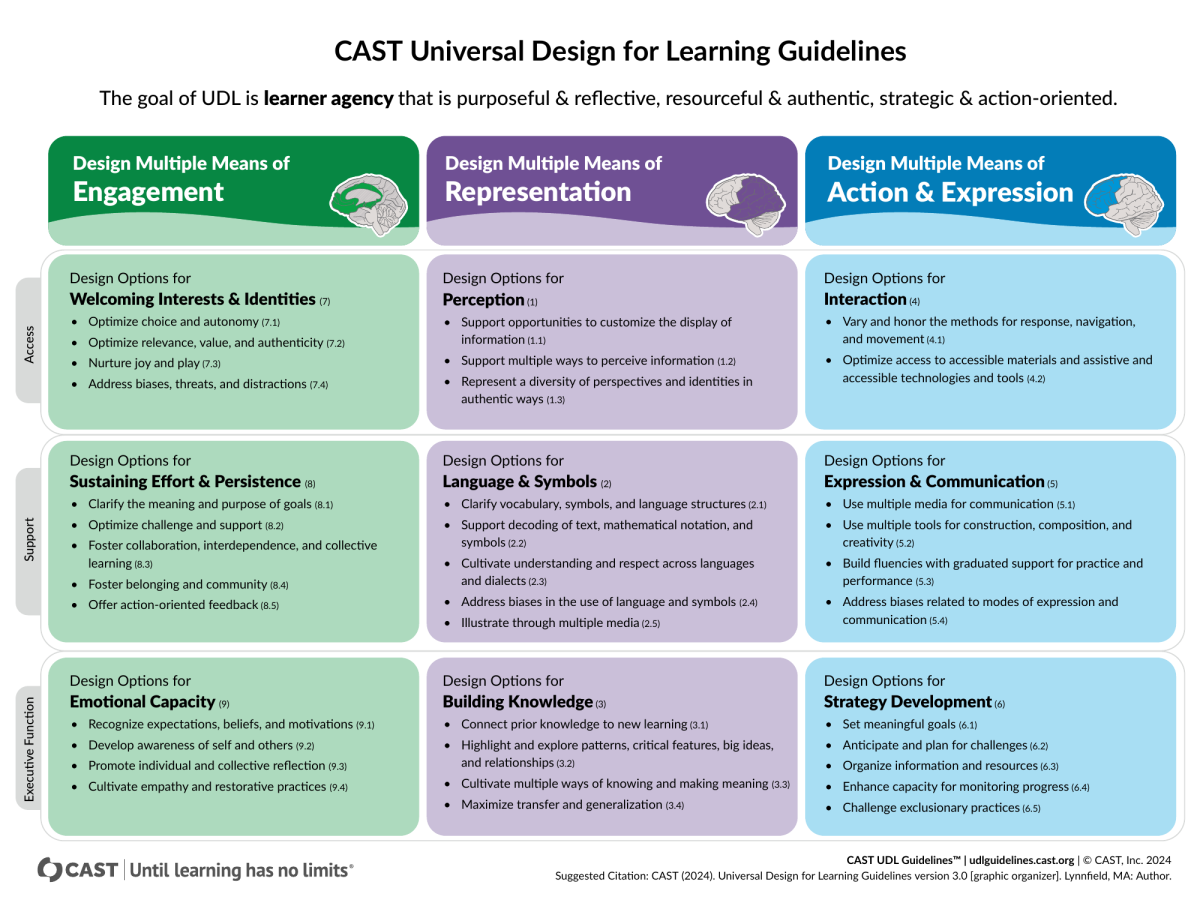
Explore CAST’s accessible, interactive guidelines · Download the full-size organizer and translations
Source: CAST (2024), Universal Design for Learning Guidelines version 3.0. Original graphic reproduced from CAST’s PDF.
Start with one lesson
Open a topic for practical strategies and an example you can use.
- Engagement: How else can students connect and participate? Offer relevant choices, thinking time, and feedback.
- Representation: How else can students access and understand? Pair accessible text with diagrams or captioned explanations; clarify vocabulary.
- Action and expression: How else can students show learning? Offer aligned response options, practice, and planning supports.
Review the CAST guidelines above as you choose a strategy for your lesson.
Build it: observable action + content or skill + relevant conditions + success criteria.
Instead of: “Understand credible sources.”
Try: “Given two sources about one claim, evaluate their credibility using authorship, evidence quality, and relevance; justify a judgment with evidence from each.”
Assess: accurate use of criteria, relevant evidence, and justified reasoning. Define proficiency in a shared rubric. Objectives guide assessment; aligned student work provides evidence of learning.
If writing is not the target skill, students might respond through text, audio, or annotated slides. Keep essential writing, speaking, or practical skills when those are the outcome.
- Goal: evaluate a claim using credible evidence.
- Barrier: unfamiliar vocabulary and unclear expectations.
- Learn: provide an annotated example, a glossary, and a captioned explanation.
- Engage: let students choose a relevant claim; schedule a feedback checkpoint.
- Show learning: offer a written analysis, audio explanation, or annotated slides when the format is not the target skill.
- Assess: use common criteria for evidence and reasoning, then ask which supports helped.
Keep options comparable in scope and accessible. UDL complements individual accommodations; it does not replace them.
Ask: what must students demonstrate themselves, and what role may AI play?
- State permitted AI uses and how students should acknowledge assistance.
- Require evidence of reasoning: source checks, choices, revisions, or a demonstration.
- When AI is optional, offer a comparable route without it and assess the same criteria.
Try: students critique an AI-generated source comparison, verify its claims, and explain corrections. An instructor-provided comparison offers a parallel route. Both assess evidence and judgment.
OSU’s graphic below is a reflection tool. Its examples reference GPT-4 as of October 2023; higher-level Bloom’s verbs alone do not establish independent learning.
Choose the thinking
Use Bloom’s verbs to clarify the learning you want to assess. The task as a whole determines cognitive demand. A verb alone does not establish the level of thinking.
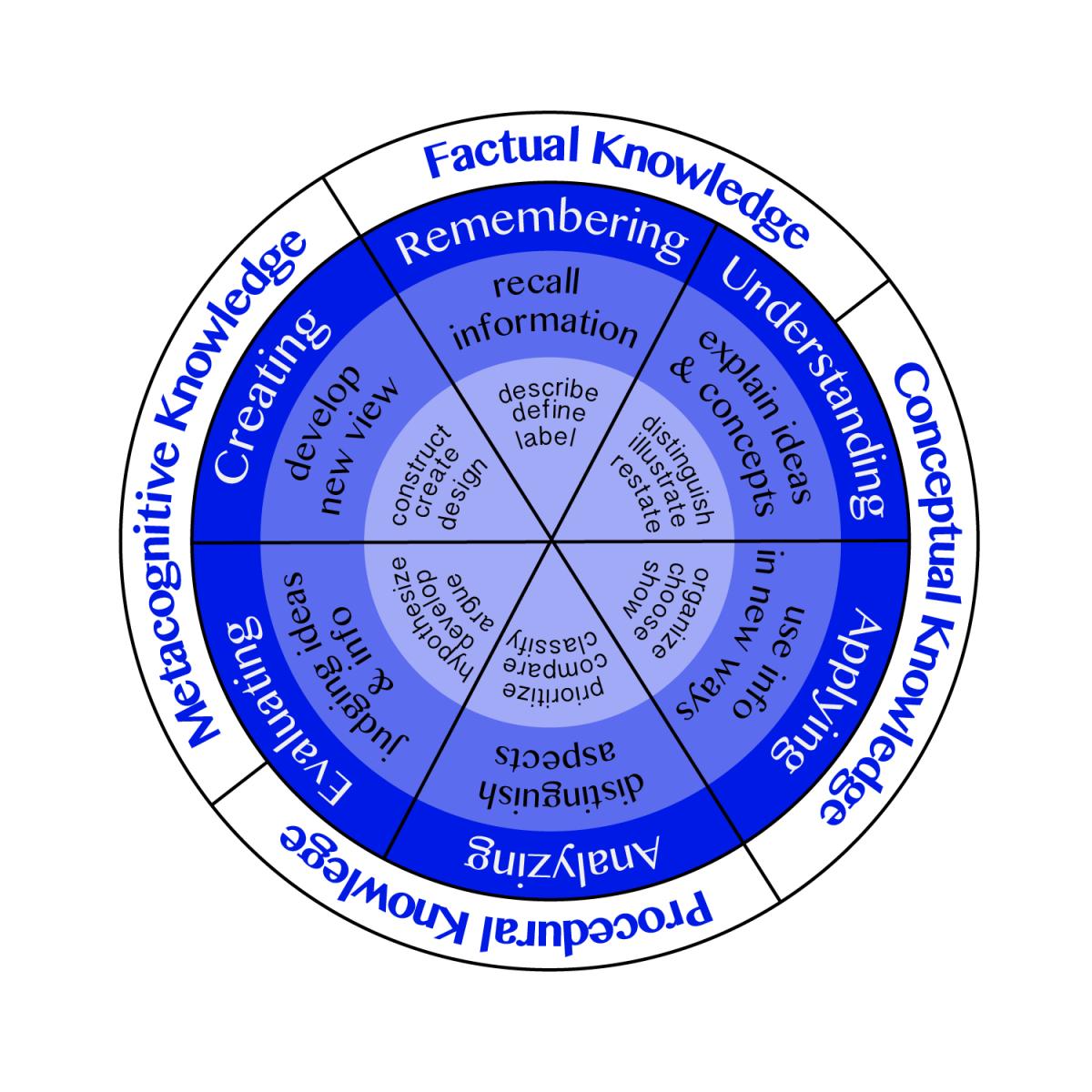
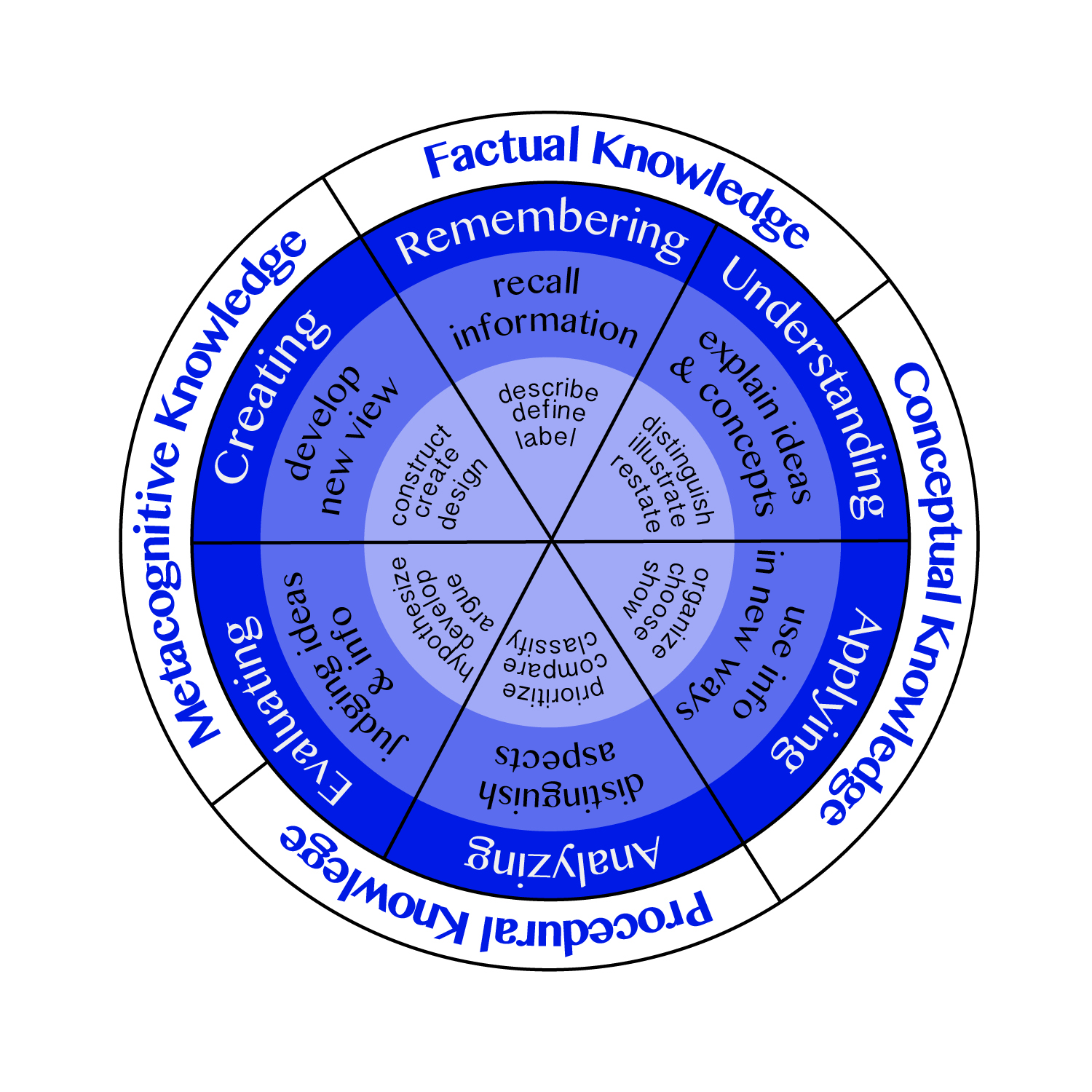
Original wheel published by the University of Utah CTE, adapted from Edutechalogy. Read the text guide and verb examples.
Make thinking visible with AI
Use OSU’s comparison to reconsider what students need to practice and what evidence will show their own learning.
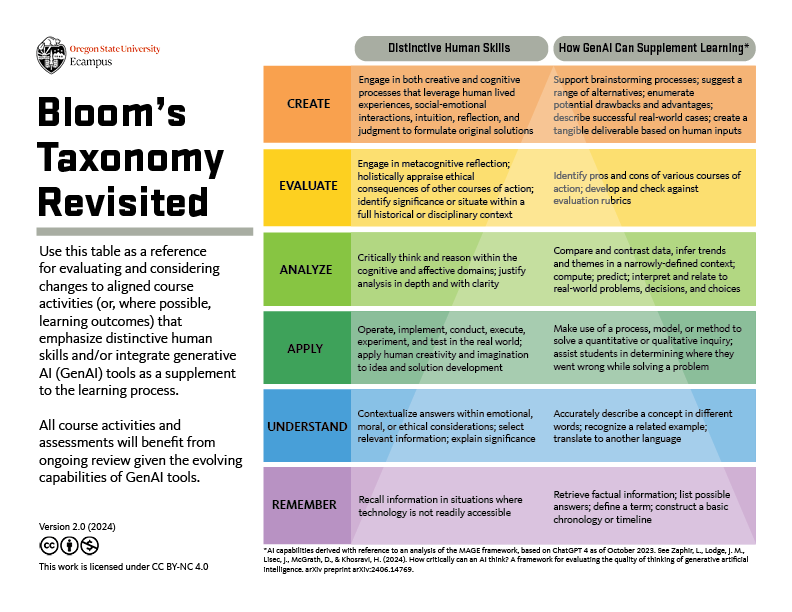
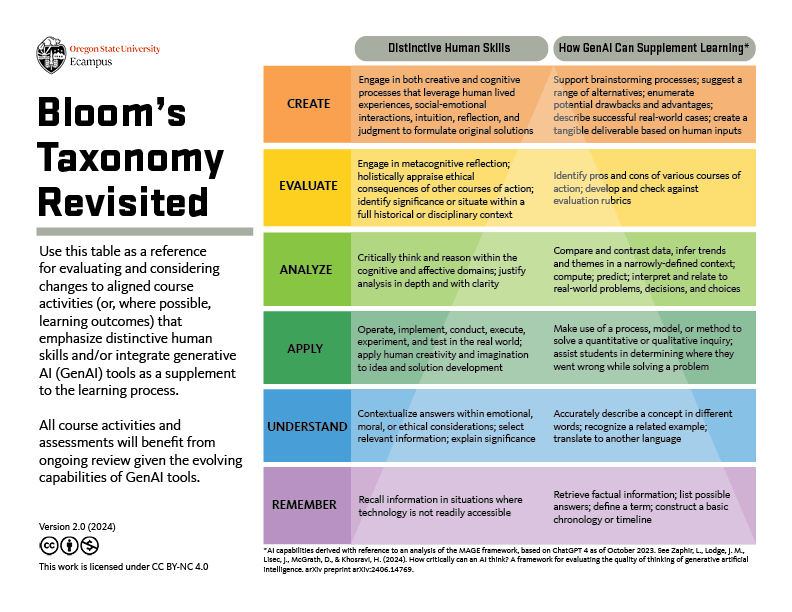
Oregon State Ecampus, Bloom’s Taxonomy Revisited, version 2 (2024), CC BY-NC 4.0. AI examples reflect GPT-4 in October 2023.