Laboratory Hazard Assessment for Instructors
When planning a new lab or lab-related activity, a hazard assessment is required.
Note: New Lab Proposals need to be submitted by the end of the second week of the prior academic term.
The LabHaz Form must be completed by the instructor. The LabHaz Form is then submitted to the appropriate Lab Coordinator along with a detailed lab procedure. After review and approval, the Lab Coordinator submits the form to the Chemical Hygiene Officer for final review/approval.
Link to LabHaz Form
Life Sciences Lab Coordinator: Adam Gabay
Physical Sciences Lab Coordinator: Jordan Mohrhardt
Laboratory Work Hazard Assessment for Student Research Projects (Organic Chemistry)
A Laboratory Work Hazard Assessment form is given to students by their instructor before they can be approved to conduct research projects in chemistry. The completed form is submitted to the Physical Sciences Lab Coordinator and Chemical Hygiene Officer for approval along with the Organic Research Proposal and experimental procedure.
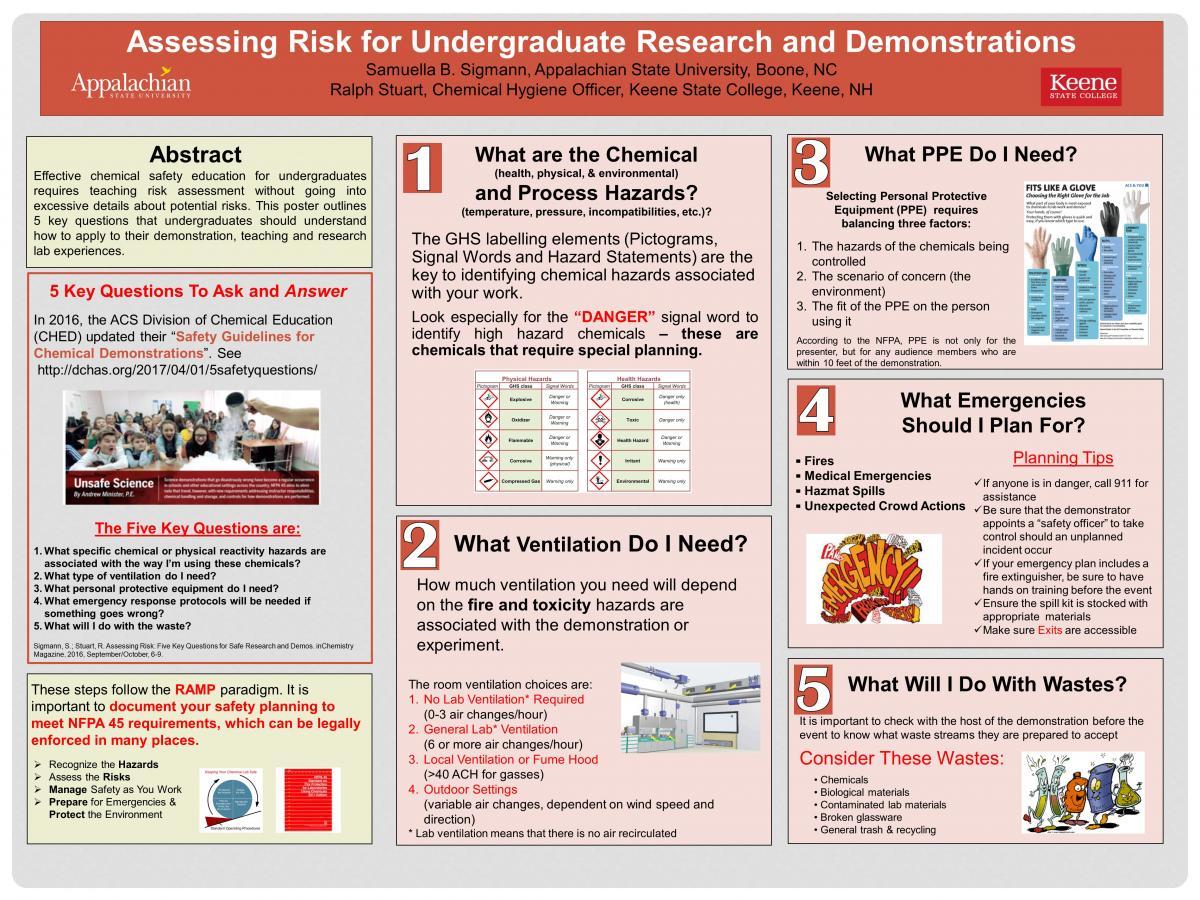
Assessing Risk for Undergraduate Research and Demonstrations
Effective chemical safety education requires understanding potential risks without overwhelming detail. Use these five key questions to plan safe demonstrations, teaching labs, and research activities.
1. What are the chemical and process hazards?
Identify hazards related to:
- Chemical properties (health, physical, environmental)
- Process conditions (temperature, pressure, incompatibilities)
Use GHS labeling elements:
- Pictograms
- Signal words (especially Danger for high-risk chemicals)
- Hazard statements
High-hazard chemicals require additional planning and precautions.
2. What ventilation do I need?
Ventilation needs depend on fire and toxicity risks.
Common options include:
- No lab ventilation (0–3 air changes per hour)
- General lab ventilation (6 or more air changes per hour)
- Local ventilation (e.g., fume hood)
- Outdoor settings (variable airflow depending on conditions)
Choose ventilation appropriate to the level of risk.
3. What personal protective equipment (PPE) do I need?
Select PPE based on:
- The hazards of the chemicals being used
- The environment or scenario
- Proper fit for the person using it
Ensure PPE is appropriate for both presenters and nearby participants.
4. What emergencies should I plan for?
Plan for:
- Fires
- Medical emergencies
- Hazardous material spills
- Unexpected audience reactions
Preparation tips
- Assign a safety officer for the demonstration
- Have emergency contacts readily available (call 911 if needed)
- Ensure proper training on safety equipment
- Keep spill kits stocked and accessible
- Make sure exits are clearly marked and accessible
5. What will I do with waste?
Plan ahead for proper disposal of:
- Chemical waste
- Biological materials
- Contaminated lab materials
- Broken glass
- General trash and recycling
Coordinate with your institution to ensure proper handling and compliance.
Safety Planning Framework (RAMP)
- Recognize hazards
- Assess risks
- Minimize risks
- Prepare for emergencies
Document your safety planning to meet institutional and regulatory requirements (e.g., NFPA 45).